
Marx Vintage Dollhouse Furniture, Traditional Line Patio/Outdoor, 1/2" Scale, SOFT Plastic
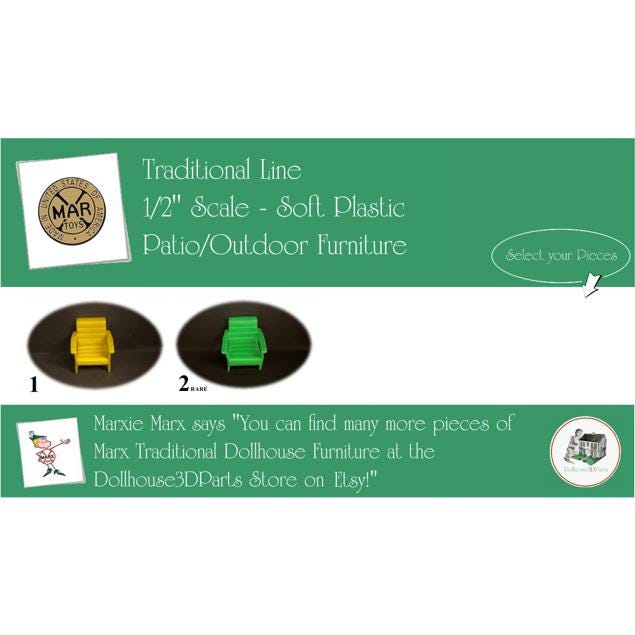
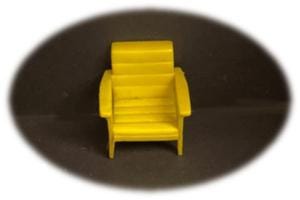
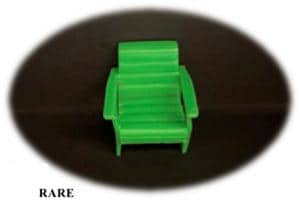
$3.50
If you’re diving into the world of Marx 1/2" scale (1:24) dollhouse furniture, you are looking at one of the most iconic "grocery store" toys of the 1950s and 60s. While Marx is famous for its lithographed tin houses, the soft plastic furniture was the "magic" that brought those houses to life.
Here is everything you need to know about the Traditional Line in soft plastic.
1. Defining "Soft Plastic" vs. "Hard Plastic"
Marx produced two distinct types of 1/2" scale furniture. Collectors often confuse them, but the difference is tactile:
Hard Plastic (Polystyrene): These are rigid, shiny, and prone to snapping or "chipping." If you drop a piece on a wood floor, it "clinks."
Soft Plastic (Polyethylene): This is the version you’re likely asking about. It has a matte finish, a slightly waxy feel, and is flexible. You can bend the legs of a chair without it snapping. It was marketed as "unbreakable," which made it perfect for younger children who might step on their toys.
2. The Style: "Traditional"
Marx categorized its furniture into lines. The Traditional Line was designed to look like a mid-century American home trying to feel "classy."
Aesthetic: Think "Grandma’s house in 1955." It features faux-wood graining molded into the plastic, cabriole legs on tables, and "upholstered" textures on sofas.
Key Pieces: The set usually included a curved "sectional" sofa, a high-back wing chair, a television console (essential for the era), a kitchen set with a "fridge" and stove, and a bathroom suite.
3. The Scale: 1/2" (1:24)
This is a critical point for collectors.
The Fit: This furniture was designed specifically for Marx’s tin litho dollhouses (like the Colonial or the Split-Level).
The Math: In this scale, 1/2 inch equals 1 foot. A standard 6-foot-tall man would be represented by a 3-inch figure.
Compatibility: It is much smaller than the standard 1:12 scale (1 inch = 1 foot) used by hobbyists today. If you try to put this in a modern 1:12 dollhouse, it will look like "furniture for ants."
4. Colors and Identification
Marx used a very specific color palette for the soft plastic line:
Common Colors: Cream/Off-white (kitchen/bath), Red, Soft Blue, Yellow, and "Maize."
The Logo: To verify it's a genuine Marx piece, look at the bottom or back. You should see the famous "MAR in a circle with a large X through it" logo.
The "Mar" Misconception: Because the X is so large, many people misread the logo as just "MAR," but it is definitely Marx.
5. Rarity and Value
Condition Issues: While the soft plastic doesn't break easily, it warps. Over 70 years, the legs of tables or chairs can become "bowed" or slanted due to heat or pressure in storage.
"Vinegar Syndrome": Some early soft plastics can develop a sticky residue or a vinegar-like smell as the plasticizers break down.
Value: Individual pieces are very affordable (often $3–$8), but finding a complete, un-warped set in a single color can be a challenge.
Condition: All items should be considered in good played-with condition.
Items Marked RARE: RARE items include:
Items that are difficult for me to acquire
Items that are difficult for me to acquire in good condition
Items that are difficult for me to find in that color
Items that are difficult to find molded in hard plastic
A combination of the above
#2 Patio Chair- difficult to acquire in Bright Green
Important! I use stock photos to illustrate my items. Please understand that the piece of furniture you select may not be the EXACT piece depicted in the photo.
Please check out my many other dollhouse listings on Etsy
Thank you for considering a purchase
Shipping from United States
Processing time
1-2 business days
Customs and import taxes
Buyers are responsible for any customs and import taxes that may apply. I'm not responsible for delays due to customs.